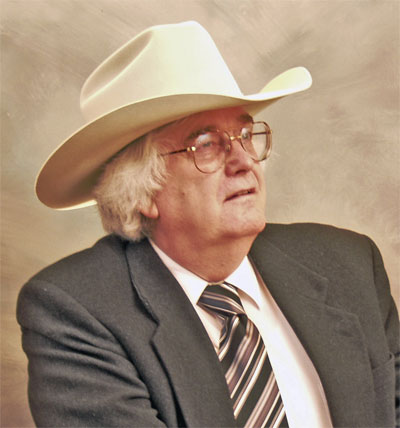
 |
Retired Professor of Religion Gardner-Webb University Boiling Springs, North Carolina |
|
Retired Professor of Religion Gardner-Webb University Boiling Springs, North Carolina |
last revised: 03/29/17
| Who am I? | What is my educational background? |
How have I spent most of my adult life? |
|---|
I grew up in farm and ranch life at the edge of west Texas during the 1940s and 1950s, near Perrin, Texas. Perrin is a small town of less than 500 people, about a seventy-five miles northwest of Fort Worth, Texas in Jack County. My parents's home place was about three miles southwest of Perrin. I was born Nov. 3, 1941 at my maternal grandparent's home, just "across the creek" from where I would grow up. My father worked as a cowboy on a large ranch for the first several years after he graduated from high school. When my father and mother married in 1939, he continued working for Mr. Harvey Marcs on his ranch until dad bought the Goddard place southwest of Perrin. Shortly after I was born, they moved to their new home and that's where I lived until I graduated from high school in May of 1960. The place initially covered 100 acres, but was gradually expanded later to 180 acres. During those years, my dad leased or rented another three to five hundred acres of both pasture and cultivated farm land. Still, this was a small place in comparison to many of the ranches in the area. Across the road from us was the 3,200 acre Smith ranch. The Cherryhomes ranch just north of Perrin was the largest with around 30,000 acres, and now is the known as the Henderson Durham Ranch.These growing up years were filled with hunting, fishing and lots of hard work. There was cotton to hoe in the summer and then to hand pick in the fall. Cattle and hogs needed "working" and periodically to be shipped to the stockyards in Ft. Worth. One of special joys as a youngster was to get to go with my dad to the Ft. Worth Stockyards with a trailer load of either calves or hogs. In my growing up years, that represented the outer limits of my world. Chores were assigned to my younger sister and brother, as well as to me. These were daily responsibilities come rain or shine every day of the week. The eggs had to be gathered daily, the pigs fed, and the milkcows milked. But in the occasional free moments, my most prized activity was to grab my dad's single shot 22 rifle, the cain fishing pole and a can of worms. My buddy, Shorty (the bulldog who was born the same day that I was), and I would head off early in the morning to the pastures to spend the day fishing, hunting and just walking around exploring things. Returning about sundown in the evening, we seldom had any fish or game, but we brought back a day full of fun memories. A bag of crackers and chunks of American cheese was all we needed or wanted for lunch. I did this from about age five until I graduated from high school, even after old Shorty died at 13 years of age.
Since I grew up in the post-WWII boom years, the economic atmosphere in this small community was very positive. This became especially true when oil and gas were discovered in the early 1950s. Many individuals became very wealthy because of having massive amounts of oil and gas on their property. Unfortunately, my parent's place wasn't one of them, although a couple of oil wells were drilled and still produced some oil until the early part of this century. The main benefit came to the school district. In Texas, school districts are divided into Independent School Districts which operate completely separate from other governmental agencies and have their own taxing authority. As a consequence of this legal structure and the massive amounts of oil and gas income generated for the school, Perrin Independent School District (now the Perrin-Whitt Consolidated Independent School District) charged almost no taxes to the local property owners, paid cash for everything, and provided substantial extra bonus income to its teachers. The net result was that this small school district with less than 200 total students had some of the finest, best educated teachers found anywhere in the state of Texas. The facilities were equal to, or better than, any of those found in the largest schools in major cities in Texas. Thus, the students were exposed to outstanding educational opportunities despite its small size. Consequently, many of its graduates have gone on to become leaders in many fields of endeavor across the nation.
Sports occupied a central place in school life. The small high school with only about 75 students didn't play football at that time, thus we played basketball about "13 months" out of the year. Track and baseball were spring sports, but mostly served as preparation for basketball in the fall. Usually Perrin high school was in competition in both boys and girls basketball for district and bi-district championships about every year. The school had won a state championship a time or two during those years. Every year of the four years that I managed to "letter" in basketball, the boys team was district or bi-district champs or else runner-up. So also were the girls teams. Playing basketball was one of the highlights of my high school years, and I was good enough at it to average about 20-25 points per game during my sophomore through senior years.
After graduating from high school in May of 1960 as class Salutatorian in a class of nine students, I began my college studies at East Texas Baptist College (now East Texas Baptist University) in Marshall, Texas in the fall, majoring in Religious Studies. After my freshman year there, I transferred to Wayland Baptist University in the Texas panhandle at Plainview Texas, where I finished my BA degree in Religious Studies in May of 1964. The open spaces of west Texas suited me more than the piney woods of deep east Texas where EBTC was located. During the Wayland days, I was married and our first child was born shortly before my senior year at Wayland. Working in the West Pharmacy in downtown Plainview for most of that time helped keep my feet anchored in the real work of business, as well as earn enough money to pay for the expenses that college scholarships didn't cover. Lots of preaching opportunities came from all over west Texas during those years, since Baptist churches out there enthusiastically support Wayland and her ministerial students. I had "cut my preaching teeth" at the TB Hospital in Shreveport, Louisiana my freshman year at ETBC when several of us "preacher boys" traveled each Sunday evening from Marshall to preach in the various wards of the hospital. That group of African-American women who patiently listened to their "white preacher boy" each Sunday evening gave me much undeserved encouragement. I will be eternally grateful to them for allowing me to learn to preach with them.With college graduation came the decision about where to go to seminary. During my junior year of high school I had "accepted a call to ministry," after wrestling with God about it for over a year. My high school years were increasingly pointed to an appointment to the Air Force Academy and afterwards a degree in aerodynamical engineering at MIT in Boston. My dream was to design and fly airplanes. The test pilot Chuck Yeager was my inspirational model. But God had other plans that I eventually accepted, even though at the time I could not have imagined where He would take me in that plan. Thus, seminary education was an expectation rather than an option. Since Southwestern Baptist Theological Seminary was reasonably close to home and had the best opportunities for Southern Baptist ministerial students, I chose to move my family to Fort Worth in the summer of 1964 to begin seminary in the fall.
During those MDiv studies at SWBTS, I began wrestling with whether or not God was calling me into missionary service. After seminary classes began in Sept. of 1964, the then First Baptist Church of Graford Texas called me as pastor. I was happy being a pastor, even though during those four years of MDiv studies, I drove 150 miles each day to and from the church field to the seminary in Fort Worth. The church was in small town ranch life and I was able to relate to the people since I had a similar background. Graford was somewhat challenging, since the school there had been our bitterest competitor in sports all through my high school years. But I knew lots of people there, and was able to overcome that long time sports rivalry between Perrin and Graford. Toward the end of the four years of both master's degree studies and the pastorate there, the struggle with missions grew to where I made a commitment to go to the missions field. But by this point that calling was to theological education on the missions field. That meant a doctors degree must be completed before the calling could be realized.
When I graduated from Southwestern with a Masters of Divinity degree in May of 1964, I sensed that God was also calling me to a new congregation to pastor, as well as to begin my ThD degree at the seminary in the fall of 1964. During that summer, Springdale Baptist Church in Ft. Worth, Texas called me as their senior pastor. While the Graford church had averaged about 75 in Sunday School, this new urban congregation would have around 250 or so in Sunday school. With a multiple staff, I was entering into a brand new world of pastoral leadership. The challenge of juggling family life, doctoral studies, responsibilities as a seminary teaching assistant, and pastoring put my scheduling ability to the test. To be sure, all of these had been present since my second semester of MDiv seminary studies when I was asked to serve as Dr. MacGorman's assistant in the New Testament department. But with more intense seminary studies and a much large pastoral responsibility, I had to learn how to manage my time very efficiently.
But the six years that I was pastor at Springdale church were some of the happiest and most fulfilling of my life. This urban church on the edge of the inner city of Ft. Worth grew and underwent a profound spiritual awakening during 1970 that continues to keep the congregation vital and spiritually alive even to this day, some 40 plus years later. When I was nearing completion of the doctoral studies in the fall of 1973, the process of missionary appointment kicked back into full gear. But disappointment came when the Foreign Mission Board of the SBC delayed approval of our application because of earlier health issues that I had some years back. That left us unsure of what God's leadership meant career wise. I loved pastoring the Springdale congregation and felt that once the doctorate was completed I would become just a pastor for the remainder of my career. I didn't understand the reason for the doctoral studies, since that had become necessary because of the anticipated missionary career. And now that seemed increasingly out of the picture.
Then out of the blue in January of 1974, I received a phone call one Saturday afternoon from Dr. Huber Drumwright, then dean of the School of Theology at Southwestern. He extended to me the invitation to join the New Testament department as a professor of New Testament and Greek. I had no forewarning of this; I wasn't even aware that the NT depart was considering adding a professor. After careful and prayerful consideration over the next week or so, I accepted the invitation to begin in August 1974 as Instructor of New Testament and Greek. So in late July, after we returned from a youth mission trip with about 40 Springdale young people and adult sponsors to Ann Arbor Michigan, we moved to the south side of Fort Worth to begin a twenty-three year plus teaching career at the seminary. The toughest part of all this was leaving a much loved congregation who had been a delight to pastor and who loved us dearly.
The first year of teaching full time also meant finishing up a doctoral dissertation. Additionally, my mother was diagnosed with lung cancer that same fall. The next thirteen months she spent fighting a loosing battle with that dreaded disease. She and dad lived with us much of that time so that she could take chemotherapy treatments at the nearby St. Joseph's Hospital in Ft. Worth. Much to my sadness she died in September the following year, before my December graduation with my doctorate. She had served as Minister of Music for almost a quarter of a century in the home church at Perrin, and took special pride in one of her children being in vocational Christian ministry.
Some glimpses into specific episodes in my life can be read from several of the posted short stories that I have written over the years.
The next two plus decades were spent teaching New Testament and Greek at Southwestern seminary. During that time the enrollment of the seminary topped 5,500 students in the late 80s, thus becoming the largest and one of the most prestigious seminaries in North America. By the early 80s, my teaching responsibilities in the NT dept. began migrating toward advanced masters level courses and doctoral seminar teaching and supervision. The Greek courses remained the core responsibility at the masters level and year long New Testament Critical Methodology and New Testament History seminars gradually became the teaching focus at the PhD level. Also during that time I was asked to assume the responsibility of director of the newly formed Modern Language Studies Program, and I served as its director until 1992 when the seminary added a new professor to assume this responsibility. Also, after the first sabbatical leave at the university in Bonn Germany I taught the second year of Theological German in this program in addition to serving as the director of the entire program. In the early 90s the seminary president asked me to put together a MA seminar called "Computers in Ministry," which I co-taught with the technology director of Robert's Library until my retirement. In my "spare time," I served as interim pastor, revival preacher, supply preacher, and Bible conference teacher in numerous churches over Texas, Arkansas, Louisiana, and Oklahoma. This involvement in local church ministry helped me to orient what I taught in the seminary classroom to where the students would eventually come in ministry after graduation. One of the most delightful extra activities during the years was involvement in professional societies for biblical studies professors. This meant attending the annual national and regional meetings of the Society of Biblical Literature, the National Association of Baptist Professors of Religion, and the Institute for Biblical Research. Fortunately, in the north central region of Texas two other area professional groups were active: the Southwest Biblical Seminar and the Seminar on the Development of Second Century Christianity. Through participating and serving as an officer, occasional presenter etc. in these groups, many valued friendships with colleagues in other schools were developed.Two special opportunities during the seminary years proved especially enjoyable and influential in my teaching career. Southwestern Seminary had a very generous sabbatical leave program; every seven years it allows a professor to take a full twelve months off from teaching responsibilities at full salary and benefits plus travel expenses outside the US. In anticipation of my first sabbatical leave, I spent the summer studying German at the Goethe Institut in Freiberg Germany in 1980. My first sabbatical leave (1981-82) was spent working as a guest research professor at the University of Bonn. During the year I accepted an invitation to deliver lectures at the German Baptist Predigers Seminar then located in Hamburg; it is now the Theologisches Seminar Elstal and is located near Berlin. The sabbatical year was spent attending classes, doing intensive research, and developing skills with the German language. The second sabbatical leave (1990-91) was spent at the University of Heidelberg. Similar activities filled up my time there. Additionally, I was invited to give guest lectures at the universities in Bonn, Göttingen, Heidelberg and the Prediger Seminar in Hamburg during the year. During both sabbatical leaves, the opportunity came to preach in several German Baptist congregations, which put my German skills to the test as much as the academic lectures and writing did, and in several European Baptist Convention (now the International Baptist Convention) English language churches in Germany. Many lasting friendships have come out of those experiences. Also, opportunities came to try my hand at writing German in a more popular style with two published articles in the German Baptist monthly magazine Die Gemeinde. During the summer of 1990 before beginning the work in Heidelberg, I was privileged to attend the Alliance Française in Paris France in order to develop better oral skills with the French language. Such opportunities could never have even been imagined while growing up in Perrin, Texas! God's plan for me had many surprises and wonderful twists and turns.
For most of that time, my assumption was that I would retire from SWBTS at the end of my career. But with the explosion of the so-called Southern Baptist Controversy into seminary life in the 80s, that assumption became less and less certain. By the mid-90s, I became convinced that I could no longer remain with integrity in a seminary atmosphere saturated with suspicion, ungodly treatment of individuals, and growing distortion of the teachings of the Bible. But I wasn't sure where God wanted me to go. When two separate churches in Germany tried to call me as pastor, but God wouldn't give me the green light to say yes, I became even more puzzled about future directions. Then again, out of the blue like the seminary invitation, there came the opportunity to move to North Carolina to begin teaching at a Baptist university that I hardly knew existed beforehand -- Gardner-Webb University. So in December 1997, I took early retirement from Southwestern Seminary, and Claire and I moved to Boiling Springs, NC, just before Christmas.
The years since have been mostly pleasant and satisfying as I began teaching at the undergraduate level in the GWU Department of Religious Studies and Philosophy. With about 4,000 students at that time, the university was poised to make a substantial contribution to Baptist life, especially in western North Carolina. Coming from primarily teaching doctoral students to mostly teaching undergraduate students presented a substantial challenge in the beginning years. But the challenge of working with students just out of high school, who are more open to exploring new ideas and are in a very formative stage of intellectual growth, has been exciting. Although I began working with computers in the middle 80s, the opportunity presented itself after moving to NC to immerse myself much more deeply in technology and the high tech world. Thus, as a way to help students, Cranfordville.com was born. That interest has steadily grown over these past years, along with programming skills together with web design and graphic design skills. As a consequence, everything connected to what I do in the class room is now linked to the Academic section of Cranfordville.com. A fist full of health problems developed in the summer of 2001 including cancer; this has slowed me down considerably but thus far hasn't forced me into a second retirement. For that I am very grateful.
But by 2008 the reality of retirement set in big time. Claire and I began thinking and projecting a retirement at the end of the academic year of 2010. Little did we know, however, what God had in store for us. In contacting the executive director of the International Baptist Convention in January of 2008 in order to offer our services to the convention in retirement to Germany in 2010, the offer came in late April to come to Germany for the summer of 2008 in order to help the then struggling International Baptist Church of Cologne. Without having the finances in hand and simply trusting God to somewhat make this happen, we committed ourselves for eight weeks in the summer to go to Germany. In addition to potential ministry, this was intended to be the opportunity to test out the long time dream of retiring In Germany and spending retirement doing research and writing. In ways that completely astounded both Claire and me, the finances and necessary paperwork came together toward the end of May that enabled us to make the trip. The most amazing part was the renewal of our expired US passports in less than ten days!
On June 15, 2008, we arrived in Cologne Germany to begin the eight week ministry with the church. By that point in time, the congregation had dwindled down to about a dozen members, almost all of whom were African immigrants to Germany. The church was heavily in debt and its survival was an open question. My assignment from the convention leaders was to see if we could help the church survive and turn a corner into a brighter future. The challenges of pastoring an international church are enormous, and very different than pastoring one in the US. But God took over control and with some firm directives laid down in agreement with the church leaders, the church began moving forward and coming out of the mess it had gotten itself in. At the end of July, the church voted to call us as pastor of the congregation. The leadership of God was so clear both to Claire and me, as well as to the congregation, that we accepted the call on a two year contract to serve. But Claire and I had to return to NC in order to finish out our teaching obligations there during the fall semester. We were able to secure the services of the founding pastor of the church to come over from California for four months to help with the revival of the church. Thus at the end of December 2008 we had finished our teaching obligations and formally took retirement from them, as well as packed up some belongings to ship to Germany and desposing of all the rest. On Dec. 28 we boarded the plane to Germany in order to begin this new adventure in what we assumed would be a retirement two years earlier than planned.
From January 2009 to August 2010, we worked full time with the church in Cologne. The blessings of God brought the church back to almost a hundred people in weekly attendance, and the expanded outreach of the church to include individuals from over a dozen nationalities, including several Germans who came into the life of the church. God marvelously blessed the finances of the church so that they operated in the black this entire period of time while accumulating a surplus of some 32,000 Euros. The down side of all this for Claire and me was that this explosive growth brought with it gigantic increases in pastoral responsibilities. These began overwhelming me, and damaging my health as a 68 plus year old fellow not in too good a health from the beginning. It became clear to us that the church now needed a younger, more energetic pastor who could lead the congreation more effectively than we were able to.
We originally had planned to retirement in Germany, but again this was our dream rather than God's intention. The cost of living in Germany gradually became overwhelming to our limited retirement income. In praying about what to do, the Lord again wonderfully opened the door, completely unexpected to us, to move to Costa Rica, where the closest IBC church to the US was then located. So at the end of August 2010 we moved from Germany to Santa Ana, Costa Rica, in order to offer ourselves in volunteer service the the IBC Baptist Church of San José, Costa Rica. This time we were not on the church staff, and just available as volunteers.
God put me to teaching one of the adult Sunday School classes very quickly. By the end of the church year in May of 2011 Claire was elected as the church librarian and I was asked to serve on the church personnel committee. In Oct. 2011, I began teaching a Wednesday Bible study group also. Over these now five plus years, we have found places of service and continued contribution in the midst of a true retirement. We have come to love Costa Rica, its people, it scenic beauty, its marvelous climate here in the Central Valley. At the beginning all we knew was that God wanted us in Costa Rica serving Him in some capacity. He has marvelous opened doors of service to us in these retirement years.
But in the summer of 2015 time came for another major shift in our lives. Declining health coupled with advancing age began signaling to us the necessity of moving into a retirement home where our needs and limitations are more manageable. Thus, plans to move to the Texas Baptist Retirement Community in San Angelo, Texas in December of 2015 began taking shape. Thus this summer of 2015 was a 'winding down' of things in our beloved Costa Rica in order to make the move in the fall. What God has in store for us in San Angelo would become clear as time goes by. But as before, our journey is based on faith commitment to the Lord, not on sight.
On Tuesday, December 8, with sorrow and anticipation mixed together, Claire and I flew from Costa Rica to San Angelo, Texas. The month of November was hectic beyond description as we gave away most of our belongings, had movers pack up what we wanted to take with us to Texas, and, most difficult of all, said goodbye to the many, many friends in both the IBC church and in the town of Santa Ana. Lots of hugs and tears took place through all of this. We arrived exhausted at the hotel in San Angelo late that Tuesday afternoon. This would be 'home' for the next ten days as we began the process of setting up our new duplex apartment in the Village of the BRC. By December 18, we had received enough furniture, as well as our shipment from Costa Rica, so that we could 'move into' the apartment. From then through the middle of February was mild chaos as we ordered furniture etc., set it up, and began arranging things the way we desired. Added to all this was getting address changes set up, opening a bank account, leasing a car, along with a million and one other things connected with moving. The demands of all this pushed my health to the absolute brink. Fortunately no life threatening crisis arose, although blood pressure and blood sugar levelswent through the ceiling. We will forever be grateful for two of our sons who drove out from Fort Worth and spent three days each just before Christmas and before New Year's helping us put furniture together, hang pictures etc.
These early months of living in San Angelo, after somewhat getting past the stress of moving, have been thoroughly enjoyable, apart from health issues. The staff at the retirement center has been marvelous. We have met many of the residents and are making new friends easily and joyfully. Particularly nice has been the discovery of a new church home. After visiting several churches, we discovered Southland Baptist Church. As we have settled into the church, it is proving to be exactly the church we needed. We absolutely love the staff and are a part of a couples class in their early Sunday School beginning at 8:30 am. Life is slowly moving into a normal routine for us. My biggest struggle so far has been with my health. Since the middle of February, I have been slowly transitioning into US medicines from those I was taking in Costa Rica. The problems with extra high blood pressure have pretty much been resolved, but the US drugs for bloodpressure caused my blood sugar to skyrocket to levels between 400 and 550. So the challenge in March and April of 2016 has been trying to get the blood sugar down to the 100 to 115 range without messing up the blood pressure. New medicines just cause me all kinds of chaos, especially in finding a combination of medicines that don't fight one another. Although here in the middle of April, we haven't yet reached our objective, some progress has been made. The by-product has been grogginess, nausea, and dizziness, forcing me most of the time to stay in bed up to 20 hours a day. Consequently, I have only been able to work a little on the BIC commentary on Second Corinthians. Claire has gotten heavily involved in activities here are the retirement center, but I haven't yet been able to. Hopefully toward the end of April or May, all of the issues with blood sugar and blood pressure will be resolved, so that I will feel better and be able to do more. It has taken over a year in San Angelo to gradually get my blood sugar and blood pressure under control. But so far in the winter of 2017 they have been close to where they should be. The other challenge from all this has been a slow but steady loss of strength and stamina. This has now become the greatest obstacle to my health and survival.
The one constant since 1998 has been cranfordville.com, my web page. It began as a teaching opportunity where all of my classes at Gardner-Webb University were listed. The students from 1998-2008 made extensive use of the posted materials. But gradually the ministry of cranfordville expanded far beyond what I had envisioned at the beginning. Bible studies and Bible study tools were added and continue to be added in large number to the web site. An astounding number of people have discovered this and something over 225,000 people have used the site for the study of the Bible. On average now, some 250+ people per week are accessing materials for their own study. What continually amazes me it that these people are located all over the world, including places like North Korea, Syria etc. Thus my future days in San Angelo will be focused on continuing to expand and enhance the Bible study materials at cranfordville.com. The development of the Biblical Insights Commentary series, BIC for short, is at the center of this ongoing work. Thus as long as God leaves me on planet earth, this will be the continuing ministry contribution for me.
Through this long pilgrimage of ministry the focus for much of it has been the interpretation of scripture, and how to best do this. Doing ministry in Texas, North Carolina, Germany, Switzerland, France, and Costa Rica over the years has provided a profoundly rich multi-cultural personal experience that makes a big difference when coming to the sacred text. After having worked with Prof. Gerd Theissen at the university in Heidelberg in 1990-1991 on using sociological procedures for interpreting ancient texts, my interest in both the social history and the literary nature of the scripture texts has been central to this work of exegesis. Learning how to step out of one's own cultural world and to step into the social world of the very diverse first century is essential to correct understanding of the writers of the New Testament. The insights gleaned from teaching the two PhD seminars on New Testament Critical Methodology and New Testament History further contributed to this perspective on intepreting the scripture. Though these experiences and skills the balance between the human and the divine aspects of scripture has become clear and understandable. God in His graciousness has guided my unusual path over these years carefully teaching me these skills that now are being applied in writing the commentary series on the New Testament.
A continual prayer of mine reaching back some decades has for God to allow me to continue contributing in ministry in retirement until my dying breath. This He has graciously provided in so many different ways that I could never have imagined or planned out in advance. Indeed I am profoundly grateful to Him for His blessing.
 a division of---
All rights reserved©
a division of---
All rights reserved©